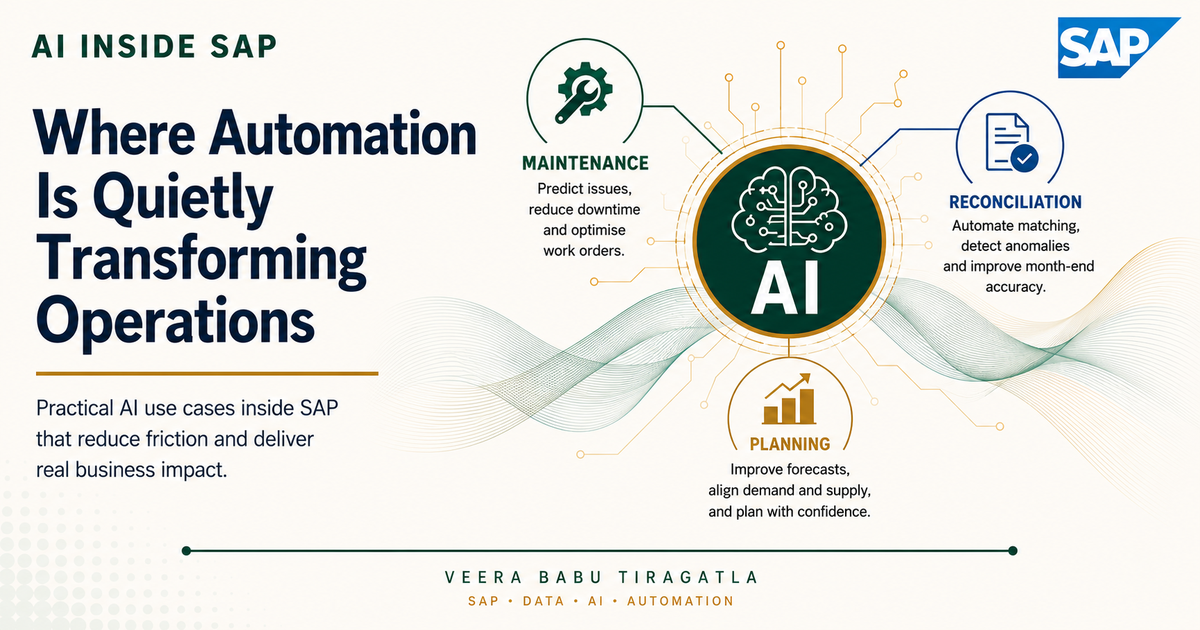
AI Inside SAP: Where Automation Is Quietly Transforming Operations
Introduction
Artificial Intelligence in SAP is no longer about dramatic digital transformation speeches.
Today, the real impact is happening quietly — inside maintenance workflows, reconciliation routines, and planning cycles. AI is smoothing out hundreds of invisible inefficiencies that normally drain time, increase errors, or slow decision-making.
Across industries, three patterns have emerged where AI is reshaping SAP operations without creating noise — but delivering very real results.
1. Predictive Maintenance: Fixing Problems Before They Break
In manufacturing, machines rarely fail without warning — but the signs are often too subtle for humans (or traditional monitoring tools) to catch.
Take a scenario where a particular pump caused major downtime every quarter.
All traditional SAP PM indicators looked normal, yet breakdowns kept happening.
When AI-based monitoring was added:
- It analysed minute vibration changes,
- Detected thermal anomalies,
- Noted acoustic deviations that humans normally ignore.
The real breakthrough came from how seamlessly SAP absorbed this intelligence:
- Early AI alerts automatically triggered SAP maintenance notifications.
- Planners had weeks of visibility to stage parts and schedule work.
- Failure-induced shutdowns dropped sharply, and costs stabilised.
This is the quiet power of AI — enhancing SAP workflows instead of replacing them.
2. Intelligent RPA: Cleaning Up the Mess Between Systems
Back-office users often spend hours reconciling mismatched data from multiple systems.
Small spelling differences, unmatched dates, or minor amount variations ripple into days of manual work.
In one finance case, reconciliation between two financial systems consumed almost an entire team’s month-end cycle.
An Intelligent RPA bot solved this by:
- Pulling data from both sources,
- Applying robust matching rules,
- Preparing 80–90% of corrections automatically,
- Leaving humans with only the judgement-heavy exceptions.
The outcome?
- Month-end pressure reduced significantly.
- Error rates dropped.
- Confidence in SAP financial data improved across departments.
AI and RPA shine when they take over predictable, rules-based work — letting people focus on decisions, not data entry.
3. Machine Learning in Finance: Strengthening Planners, Not Replacing Them
Forecasting is messy — promotions, human behaviour, supply variances, seasonality, and sudden events can distort predictions.
In one planning cycle, the objective wasn’t automation — it was decision support.
A machine learning model was trained to work alongside planners, discovering patterns such as:
- Subtle demand shifts tied to market sentiment,
- Predictable anomalies in supplier delivery behaviour,
- Gradual changes in lead times that humans rarely notice.
SAP planners remained fully in control, but with:
- Confidence bands,
- Scenario comparisons,
- Insight-driven recommendations.
Forecast accuracy improved notably — and more importantly, the planning team felt supported, not replaced.
What These Successes Have in Common
AI delivers value inside SAP when:
- It blends into existing processes,
- Its signals are auditable and trustworthy,
- It triggers actionable SAP steps (notifications, work orders, recommendations),
- Teams feel enhanced, not replaced.
The challenge is rarely the AI model — it’s integrating AI intelligence so naturally into SAP workflows that it becomes invisible, reliable, and routine.
Conclusion
AI’s power in SAP is subtle but transformative.
Small, continuous improvements — early warnings, automated matching, scenario-based forecasting — create compounding advantages across operations.
For organisations beginning their AI journey, the best path is simple:
Identify one routine decision → observe the friction → introduce a small AI assist → repeat.
Quiet improvements.
Consistent wins.
Meaningful transformation.
Tags: #AI #Automation #SAP #Predictive #ProcessMining #Analytics