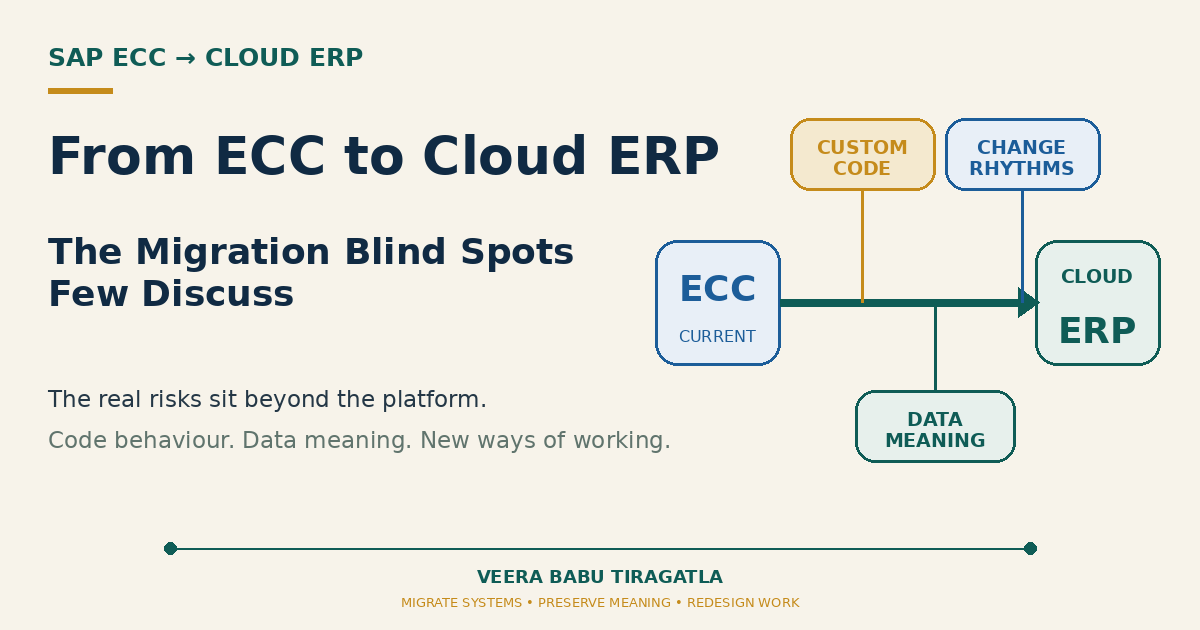
From ECC to Cloud ERP: The Migration Blind Spots Few Discuss
Introduction
Migrating from SAP ECC to S/4HANA or a cloud ERP platform is now routine — but routine does not equal risk-free. Most projects are scheduled like a technology upgrade; the real disruption comes from the behavioural, data and operational blind spots no one puts in the Gantt chart. Based on multiple programs I’ve worked on, here are three persistent blind spots — practical examples, pragmatic fixes, and what to watch for in each phase.
1. Custom Code — The Legacy that Lives on
Every ECC landscape carries decades of bespoke logic: Z-programs, user exits, local file writes and point integrations. When you move to S/4HANA or a cloud-hosted HANA environment, many of these “it-works” patterns stop working — and often in ways automated scanners won’t detect.
Rare example (not the usual “BAPI mismatch”): In a logistics-heavy client, a set of nightly batch jobs wrote temporary data to the application server’s local filesystem. On-prem that was fine. In the cloud-hosted environment, local disk access was restricted and the job silently failed on Sundays due to a timezone-related rotate script. It took three weeks to trace and re-architect those routines.
Practical fixes
- Operational rehearsals: Run your actual batches and interface flows in a sandbox that mirrors cloud permissions — watch for IO, local file use, background schedulers and timezone assumptions.
- Risk map: Identify top 20 custom objects by business impact and test them first (not last).
- Behavioural tests, not just static scans: ATC and code-metric tools are useful — but also schedule real executions to reveal run-time assumptions.
Consultant tip: Add an “operational rehearsal” gate into your migration milestones. It prevents surprises that cost weeks, not days.
2. Data Mapping — Transferring fields is easy; transferring meaning is not
ETL is familiar; semantic alignment is not. Fields that look identical often represent different business realities across divisions. Moving data without this alignment makes reports lie and decisions fail.
Less-common example: A global CPG client used the “plant” field in three different ways — physical site, tax region and a regional cost allocation bucket — depending on the business unit. The field transformed correctly, but downstream analytics aggregated incompatible dimensions, leading to a sudden, unexplained drop in replenishment accuracy post-cutover.
Practical fixes
- Semantic Alignment Day: One focused day where finance, operations, compliance and IT sit together and decide the meaning of each master object. Produce a short “one-truth” mapping per object.
- Sample-driven testing: Don’t just map by schema — migrate representative records and validate business outputs (e.g., a few POs, invoices, stock transfers) end-to-end.
- Automated reconciliation + manual sign-off: Automate the checks, but always have a senior business owner sign off for key masters.
Consultant tip: Require a “data-ready” checklist before the first trial migration — it shortens testing cycles and reduces rework.
3. Change Management — It’s a rhythm, not a course
S/4HANA changes how decisions happen. It accelerates visibility and shortens the cycle of accountability. Training UI flows is not enough — you must redesign the decision rhythms and responsibilities.
Illustrative example: A finance group received live cash positions post-migration — but no one told managers the expectations changed from daily to near real-time monitoring. They defaulted to old spreadsheets, and automation benefits evaporated within weeks.
Practical fixes
- Decision moments mapping: Identify 5–10 critical decision moments (e.g., “approve supplier payment”, “release production batch”, “adjust forecast”) and run role-play simulations for those exact moments.
- Micro-learning + champions: Deliver short, scenario-based micro-learnings and create front-line “change champions” inside each function who model new behaviours.
- Adoption charter: Draft a one-page adoption charter per department (who does what, SLA for decisions, escalation rules) and circulate it prior to cutover.
Consultant tip: Simulations beat slides. Run decision simulations two months before go-live, not two weeks after.
The entanglement problem — why these blind spots multiply
Custom code, data semantics and people practices are not independent. A late code fix can break a reconciliation report, delaying training and eroding user confidence. So treat them as a single system.
Practical program change
- Run a three-week pre-flight phase before full project kick-off:
- Review top 20 risky custom objects
- Host a Semantic Alignment Day for key masters
- Draft one-page adoption charters for 3 priority departments
This small upfront investment changes timelines, testing quality and ultimately the probability of a smooth cutover.
Conclusion
Cloud ERP migration is not a sprint to new infrastructure — it’s a careful reconciliation with what you’ve built and how your people work. The difference between a migration that simply “went live” and one that delivers value is often the attention paid to the invisible details: how code behaves, what the data truly means, and how people’s daily work changes. See those blind spots early, and you’ll buy agility for the future — not technical debt.
Pro tips (short list you can copy):
- Run operational rehearsals for batch jobs (not just code scans).
- Hold a Semantic Alignment Day for master data.
- Simulate 5–10 decision moments, not just UI training.
Tags: #SAP #S4HANA #CloudERP #Migration #DataGovernance #ChangeManagement #ERPStrategy