From Data Processing to Decision Intelligence
What changed across more than twenty years of data systems—and what did not
When I began working with data systems, nobody around me called the work “decision intelligence.”
The job was more immediate. Write the program. Structure the records. Move the data from one place to another. Make sure the process completed, the numbers reconciled and the information was still there when someone needed it.
There was nothing abstract about a failed batch or a broken database relationship. The system either worked or it did not.
Today, the work looks very different. Organisations can combine operational and analytical data, refresh dashboards continuously and place artificial intelligence inside established workflows. Computing power that once demanded careful rationing is now available at extraordinary scale.
And yet, a familiar problem remains. The data can move correctly while the decision around it remains confused.
That is the change I find most important. Across programming, relational databases, data warehousing, ETL, business intelligence, SAP HANA, cloud platforms, Microsoft Fabric and AI, the technical bottleneck has steadily moved. We first struggled to process enough data. Then to connect it. Then to interpret it.
Now the harder question is this:
Can people understand what the information means, examine the assumptions behind it and act with clear responsibility?
That is the path from data processing to decision intelligence.
The progression was not a series of replacements
It is tempting to tell the history of data as a sequence of new technologies replacing old ones. That is too simple.
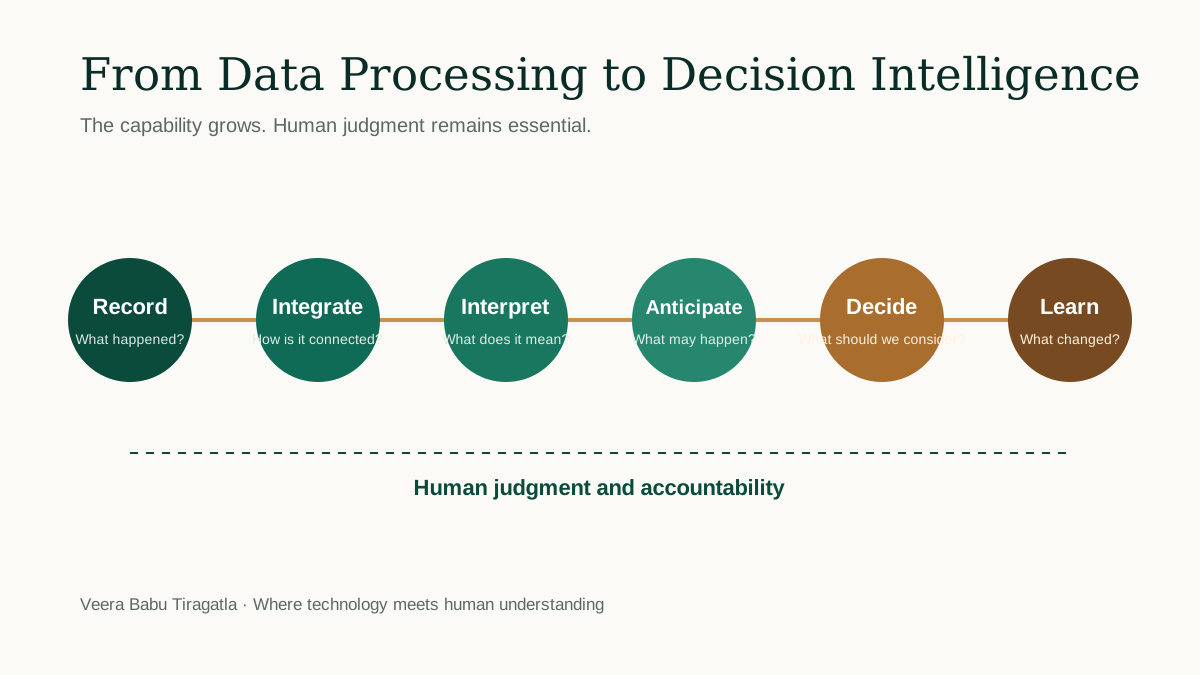
Each stage added a capability while preserving the need for the layers beneath it:
- Record: capture what happened.
- Integrate: connect events across systems and functions.
- Interpret: explain patterns, changes and exceptions.
- Anticipate: estimate what may happen next.
- Decide: compare choices, consequences and constraints.
- Learn: observe what happened after action was taken.
AI does not remove the need for reliable transactions. A real-time dashboard does not remove the need for consistent definitions. A recommendation engine does not remove the need to understand the evidence beneath its recommendation.
The stack grows. So does the responsibility.
1. Relational systems gave us structure—not agreement
Early business systems were designed primarily to record events: an order was created, a payment was made, stock moved or an employee record changed.
Relational databases brought discipline to this work. Tables, keys, constraints and relationships gave organisations a more reliable representation of their activity.
But a schema can enforce only certain kinds of truth.
It can require a value to be numeric. It can ensure that a customer identifier exists. It cannot settle whether “customer” means the buying organisation, the delivery location, the legal entity or the individual contact. That distinction belongs to the business.
This was one of the earliest lessons in data work, and it remains one of the most relevant:
Technical consistency is not the same as shared meaning.
2. Integration moves disagreement; it does not automatically resolve it
Data warehousing and ETL addressed the next major limitation. Operational systems could run individual processes, but leaders needed a view across finance, supply chain, sales and other functions.
We built pipelines to extract, transform and combine information. The result was better historical analysis and a more coherent reporting environment.
Then an uncomfortable pattern appeared. Everything could load successfully—and the numbers could still disagree.
Consider a simple example. One department treats a sale as complete when an order is booked. Another uses shipment. Finance uses recognised revenue. Each definition may be valid for its purpose. Put all three behind a single label called “completed sales,” however, and the integration layer hides a business disagreement inside a technical result.
No mapping rule can decide which definition the organisation should use without knowing the decision being supported.
Integration therefore has two jobs:
- moving and reconciling data; and
- exposing differences in meaning so people can resolve them deliberately.
The first job is engineering. The second is organisational design.
3. A dashboard provides visibility, not a decision
Business intelligence changed who could work with information. Dashboards and self-service tools brought analysis beyond programmers, database specialists and dedicated reporting teams.
That access mattered. But it encouraged another confusion: if the information was visible, we assumed it was understood.
A dashboard can show that margin is falling. It cannot, by itself, determine whether the cause is pricing, product mix, supplier cost, timing, data quality or a changed definition. Nor can it decide which response is acceptable given the organisation’s priorities and constraints.
The gap becomes clearer when we separate the stages:
Signal → Interpretation → Choice → Action → Learning
Most dashboards concentrate on the signal. Some help with interpretation. A decision system must also make the available choices, trade-offs, ownership and feedback visible.
This is why adding more charts often fails to improve decision quality. The missing element is not another visual. It is the connection between evidence and action.
4. Speed amplifies clarity—and confusion
In-memory platforms such as SAP HANA, followed by cloud data platforms including Snowflake and Microsoft Fabric, changed the speed and scale at which information could be used.
Batch windows shortened. Analytical and operational information moved closer together. Teams gained access to fresher data and capabilities that previously lived in separate environments.
These are meaningful advances. But speed can create an illusion of readiness.
A dashboard that refreshes every ten seconds can still support a ten-day argument if people do not agree on the measure, the threshold or the person responsible for responding.
Real-time data creates value only when the surrounding decision process is prepared for it. Otherwise, the organisation receives a faster signal but responds with the same unclear ownership and old working habits.
The architecture question is therefore not only, “How quickly can the platform refresh?” It is also, “What should happen differently when the information arrives?”
5. Decision intelligence is a discipline, not a product label
The term “decision intelligence” is increasingly used to describe platforms, AI capabilities and analytical products. That usage can be helpful, but it can also narrow the idea too quickly.
I prefer to treat decision intelligence as a design discipline.
Its purpose is to organise five elements around an important decision:
- Evidence: What do we know, and how reliable is it?
- Alternatives: Which realistic choices are available?
- Consequences: What may follow from each choice?
- Guardrails: Which legal, ethical, financial or operational limits apply?
- Ownership and learning: Who decides, and how will the outcome improve the next decision?
Technology can support every element. It cannot make them unnecessary.
This also helps distinguish three related capabilities:
| Capability | Primary question | Typical output |
|---|---|---|
| Data processing | What happened? | Reliable records and transactions |
| Business intelligence | What does the available evidence show? | Measures, trends and explanations |
| Decision intelligence | What choices are available, under which assumptions and consequences? | Options that support accountable judgement |
The final step is not automatically “the machine decides.” The final step is that the decision becomes better informed, more transparent and easier to examine.
Is this really new?
A fair objection is that organisations have pursued decision support for decades. Operations research, management science, decision support systems and business intelligence all tried to connect evidence with action.
That objection is correct.
Decision intelligence should not be presented as if the question began with generative AI. What is new is the combination of scale, accessible computing, connected platforms, natural-language interaction and models that can generate or recommend actions inside everyday workflows.
The ambition is not new. The reach is.
That makes older lessons more important. A weak definition spreads faster. An unexplained assumption reaches more people. A poorly assigned decision can now be automated before the organisation has properly understood it.
6. AI changes the interface, not the need for accountability
Artificial intelligence can detect patterns, summarise evidence, generate scenarios and recommend actions. Natural-language interfaces can make complex information easier to explore.
But fluent output can make uncertainty sound settled.
Prediction answers, “What may happen?” A recommendation answers, “What action appears preferable under this model?” A decision still requires someone to consider context, consequences and responsibility.
That distinction matters most when conditions change, objectives conflict or the cost of error is unevenly distributed.
AI can participate in the reasoning process. Accountability still needs a home.
What has not changed
Across every generation of data technology, three requirements have remained remarkably stable.
Shared definitions
If teams do not agree on the meaning of important terms, no platform can create lasting alignment for them.
Visible assumptions
Every model—whether a spreadsheet, dashboard or AI system—contains choices about what to include, exclude and prioritise. Those choices should be visible to the people relying on the result.
Human ownership
A system can recommend an action. An organisation still needs to decide who is accountable for reviewing, accepting or challenging it.
These are not secondary change-management concerns. They are part of the architecture of a decision system.
A practical test for any modern data programme
Before adding another dashboard, platform or AI capability, ask:
- Which specific decision are we trying to improve?
- Who makes that decision today?
- Do the people involved share the same definitions?
- Can they see the assumptions and limitations behind the output?
- Which alternatives and trade-offs must remain visible?
- What action should become clearer, faster or safer?
- How will we learn whether the decision actually improved?
If these questions cannot be answered, the programme may still produce an impressive platform. It is less likely to produce a better decision.
The next stage of the journey
What stays with me after more than twenty years of combined experience is not simply how much the technology changed. It is how often the hardest question appeared after the technical work succeeded.
The code ran. The pipeline completed. The dashboard refreshed. Then people had to decide what the information meant and what they were prepared to do about it.
The next stage will bring more capable AI, more natural interaction and systems that participate more directly in everyday work. We will still need sound architecture, reliable data and efficient processing. But those capabilities create value only when people can understand the evidence, examine its assumptions and act with judgement.
For years, we built systems to process data.
Now we are building systems that participate in how we think.
The responsibility is to ensure they help us think more clearly—not merely react more quickly.