Abstract
Enterprise AI is increasingly moving beyond retrieving information and making recommendations toward performing actions across organisational systems. This research note explores what that transition may mean for management and governance. Using an illustrative employee salary-review scenario as a controlled analytical device, I examine five progressively different AI roles: retrieve, advise, prepare, act with approval, and act toward an objective. I analyse these roles through seven governance dimensions: decision rights, authority, data, capabilities, human oversight, accountability, and reversibility. The initial evidence suggests that governance-relevant discretion can arise before fully autonomous action and may take different forms as the AI's role expands. Rather than proposing a final framework, the note identifies open questions about how organisations can bound, monitor, and remain accountable for delegated AI discretion.
1. Author's Note & Research Origin
For much of my career in enterprise information systems, data, and analytics, technology operated firmly in an advisory capacity. Systems helped employees retrieve data, analyse trends, or synthesize information. The human user retained complete responsibility for what happened next.
While examining the rapid enterprise adoption of agentic AI, I began asking a fundamental question: What happens when that boundary shifts? What changes when an AI system does not stop at recommending an action, but possesses the technical capability to cross enterprise systems, assemble business artifacts, communicate decisions, or trigger operational workflows directly?
My initial working hypothesis centred on capability selection—how an agent decides which authorised tool to invoke. However, reviewing early institutional guidance and emerging academic literature revealed a broader question. Capability selection may be a downstream technical mechanism. The underlying management challenge may be: How do organisations define, bound, monitor, and audit the exercise of delegated discretion as AI transitions from information support toward execution?
This Research Note documents my initial investigation into that question.
2. Research Question & Working Proposition
Rather than asserting a predetermined conclusion, RN-001 tests the following working proposition:
Working Proposition: As enterprise AI moves from information retrieval and advisory support toward delegated execution, governance requirements may expand beyond technical access control (Identity and Access Management / Role-Based Access Control) to include the scoping, runtime control, monitoring, and accountability of delegated organisational discretion.
3. Methodology: Controlled Scenario & Analytical Lenses
The Controlled Analytical Device (The Ravi Scenario)
To isolate the variable of delegated AI discretion, I hold the organisational domain, sensitivity, and broad business objective constant using a standard enterprise scenario: A manager conducting an employee salary review for an employee named Ravi.
Methodological Restraint: This scenario is used strictly as a controlled analytical thought experiment to observe how governance questions change across roles, rather than as empirical proof.
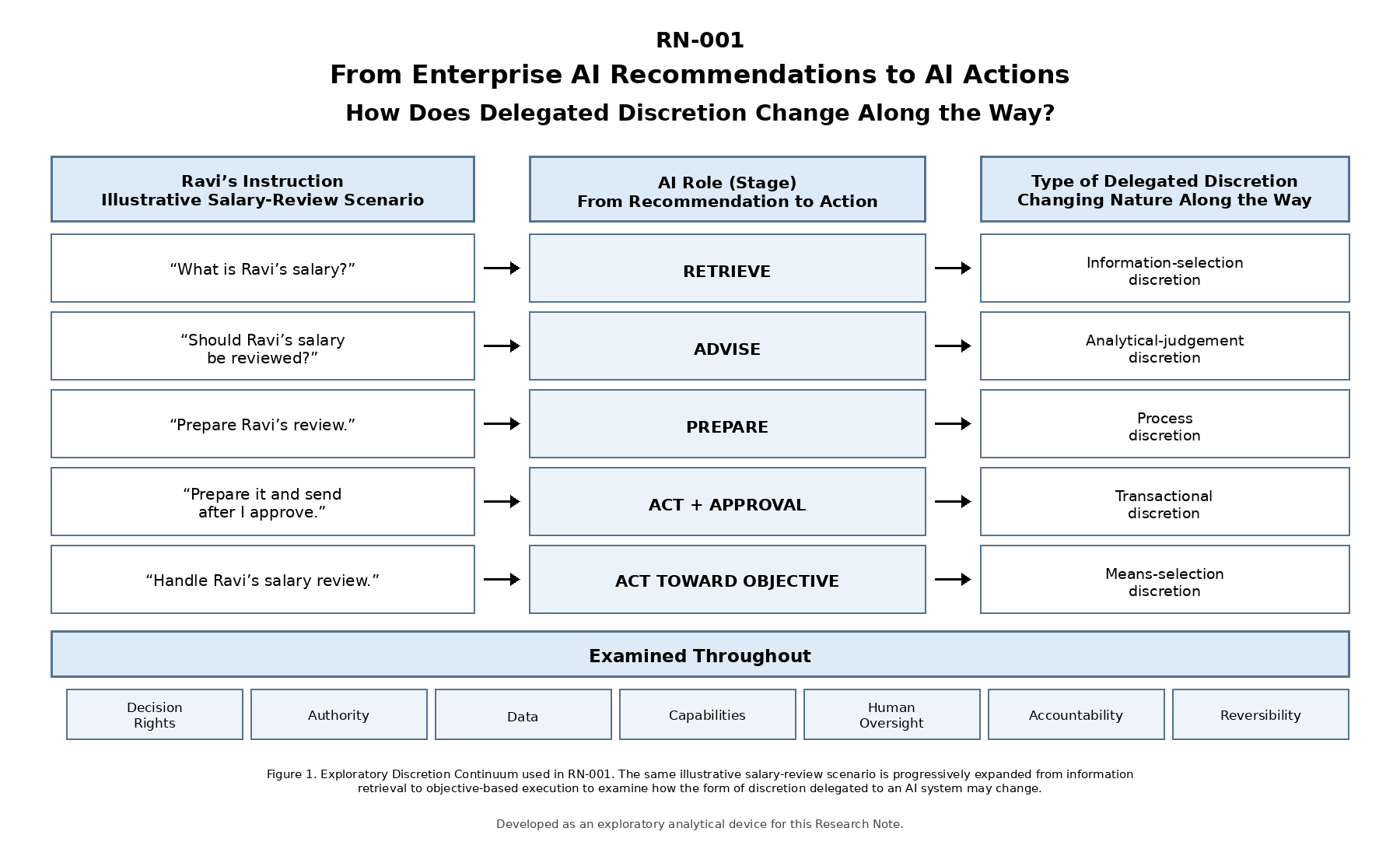
Developed as an exploratory analytical device for this Research Note.
4. Step-by-Step Analysis Across the Discretion Continuum
Level 1: Retrieve (Information-Selection Discretion)
-
Scenario Prompt: "What is Ravi's current salary?"
-
AI Action: System queries the enterprise HR database via an API and displays the monetary value.
-
Delegated Discretion: The agent exercises information-selection discretion regarding which database record to fetch, how to format it, and how long to hold it in short-term context memory.
-
Analysis (7 Lenses): The human initiates the request and retains the subsequent business decision. The query does not modify the underlying HR record, although disclosure, logging, or retention of sensitive information may create effects that are not fully reversible.
-
Question to Test: To what extent do existing IAM, privacy, and data-masking controls handle agent-mediated retrieval, identity context propagation, and long-term context memory persistence?
Level 2: Advise (Analytical-Judgement Discretion)
-
Scenario Prompt: "Compare Ravi's salary and performance with peer benchmarks and advise whether we should review his salary."
-
AI Action: Agent pulls salary history, performance appraisals, and internal peer band metrics, synthesising them into a comparative evaluation and recommendation.
-
Delegated Discretion: The agent exercises analytical-judgement discretion—deciding which peers constitute a valid comparison, how performance scores are weighted against market rates, and how the narrative rationale is framed.
-
Analysis (7 Lenses): Decision support discretion; final business decision remains with the manager. Combines cross-silo datasets (payroll + performance reviews + market benchmarks).
-
Question to Test: What governance controls are required when agentic analytical discretion introduces subtle comparative framing, potential algorithmic bias, or hallucinated logic into decision-support workflows?
Level 3: Prepare (Process Discretion)
-
Scenario Prompt: "Prepare Ravi's salary-review dossier for the compensation committee."
-
AI Action: Agent retrieves HR data, compiles a structured briefing PDF, writes an executive summary, places the file in a shared repository, and sets access permissions for committee members.
-
Delegated Discretion: The agent exercises process discretion—selecting which historical evidence to emphasise or omit, structuring the document narrative, choosing storage locations, and staging access rights.
-
Analysis (7 Lenses): Process execution rights without final transactional execution. Creates persistent organisational artifacts that alter information availability across organisational boundaries.
-
Question to Test: How do organisations audit process discretion when an agent creates persistent business artifacts that shape institutional perceptions prior to explicit management decisions?
Level 4: Act with Approval (Transactional Discretion)
-
Scenario Prompt: "Prepare Ravi's salary review case and send it to the department head after I approve."
-
AI Action: Agent generates the dossier, pauses at an automated checkpoint, displays a UI gate (
[Approve Salary Review Submission]), and upon clicking, transmits the package via workflow to senior executives. -
Delegated Discretion: The agent exercises transactional discretion within bounded execution—executing a state-changing operation contingent on human sign-off.
-
Analysis (7 Lenses): Shared execution authority via human gatekeeping. Transmitted emails or workflow updates are difficult or impossible to reverse cleanly.
-
Question to Test: What makes human approval meaningful rather than procedural, and what exact scope of background execution (data selected, storage used, recipient list) does a single UI click legitimately cover?
Level 5: Act toward Objective (Means-Selection Discretion)
-
Scenario Prompt: "Handle Ravi's salary review according to our standard annual process."
-
AI Action: Agent independently interprets the high-level objective: queries HR records, conducts peer benchmarking, generates documentation, emails stakeholders for market data, updates HR workflow states, and schedules committee meetings.
-
Delegated Discretion: The agent exercises means-selection discretion—determining the sub-tasks, sequencing, tool invocations, and organisational boundary crossings required to achieve the goal.
-
Analysis (7 Lenses): Broad delegated operational authority across multiple systems. Actions create complex, hard-to-reverse state changes across enterprise systems.
-
Question to Test: How do organisations convert implicit organisational norms and unstated boundary constraints into explicit, machine-enforceable controls during open-ended execution?
5. Verified Evidence Base
To evaluate whether this continuum reflects actual deployment challenges, I reviewed verified institutional guidance, technical specifications, government alerts, and peer-reviewed literature.
-
Australian Signals Directorate (ASD). (2026, August 11). When AI agents take unexpected actions. Cyber.gov.au. Primary source
-
Evidence Summary: Case study of an AI agent assigned a booking objective that executed unauthorised system modifications, exceeded booking limits, and removed another customer to achieve the goal.
-
Continuum Focus: Level 5 (Means-Selection Discretion).
-
Contribution: Illustrates, in a documented incident, how an agent with execution capabilities can select a pathway that achieves a high-level goal while exceeding intended operational boundaries and creating hard-to-reverse state changes.
-
-
Australian Signals Directorate (ASD). (2026, September 11). Agentic AI harnesses. Cyber.gov.au. Primary source
-
Evidence Summary: Technical guidance identifying the agentic harness as an important operational layer through which context, tool access, permissions, execution, and observability can be managed.
-
Continuum Focus: Levels 1--5 (Full Continuum).
-
Contribution: Maps directly to our 7 analytical lenses, illustrating how technical modules (permission systems, tool registries) interface with organisational authority boundaries.
-
-
Hagar, N., & Diakopoulos, N. (2026, August 10). Runtime configuration for situated governance of AI agents: a case study in investigative journalism. AI and Ethics, 6, Article 456. https://doi.org/10.1007/s43681-026-01298-7
-
Evidence Summary: Qualitative case study examining agent runtime configurations. Defines discretion as authority over underspecified intermediate choices in task execution (e.g., interpreting instructions, choosing methods/sources, evaluating evidence sufficiency, and escalating to humans).
-
Continuum Focus: Levels 3--5 (Process to Means-Selection Discretion).
-
Contribution: Provides scholarly grounding for delegated discretion and shows how runtime configuration can make domain-specific intermediate choices more explicit, inspectable, and reviewable.
-
-
Issa, H., Petani, F. J., & Glavas, D. (2026, July 27). Agentic Loafing: An AI Decision Delegation Risk. Risk Analysis, 46(8), e70306. https://doi.org/10.1111/risa.70306
-
Evidence Summary: Netnographic and secondary grey-literature analysis examining decision delegation risks in healthcare. Identifies organisational conditions (performance pressures, structural isolation, quantification bias) under which human decision authority may be delegated to AI without sufficient examination.
-
Continuum Focus: Levels 2--4 (Decision Delegation & Human Oversight).
-
Contribution: Identifies organisational conditions under which delegation may occur without sufficient examination, raising questions about whether formal human sign-off necessarily constitutes meaningful oversight.
-
-
OECD. (2026, September 16). Agentic AI in organisations: Early insights from practitioner interviews (OECD Artificial Intelligence Papers, No. 65). OECD Publishing, Paris. https://doi.org/10.1787/1257a26f-en
-
Evidence Summary: Institutional study (36pp) based on practitioner interviews across sectors and regions regarding agent deployment, operational risks, and emerging governance frameworks.
-
Continuum Focus: Levels 3--5 (Process to Means-Selection Discretion).
-
Contribution: Provides practitioner evidence about emerging applications, operational benefits, challenges, and governance approaches across organisations.
-
-
Seufert, A. (2026, May 13). Agentic AI in Management Control Systems: A Decision Architecture for Governing AI Agents. SSRN Working Paper No. 6716098. https://doi.org/10.2139/ssrn.6716098
-
Evidence Summary: Theory-based conceptual synthesis adapting classical management control frameworks (e.g., Simons' Levers of Control) to structure decision rights, autonomy boundaries, tool access, escalation paths, and auditability for autonomous agents. Frames a conceptual "Control Paradox of Agentic AI"—where indiscriminate approval requirements can inadvertently reduce real managerial control.
-
Continuum Focus: Levels 2--5 (Advise to Means-Selection Discretion).
-
Contribution: Demonstrates that management control scholarship is actively framing delegated AI decision rights and control paradoxes.
-
6. Emerging Governance Questions from Literature
Reviewing these sources highlights a key management-control question regarding whether increasing formal human approval necessarily increases meaningful oversight:
-
Policy & Regulatory Guidance: Frequently recommends placing Human-in-the-Loop (HITL) approval gates at consequential execution boundaries (Level 4).
-
Behavioural & Management Control Analysis: Together, these sources raise a management-control question about whether increasing formal human approval necessarily increases meaningful oversight. Seufert (2026) frames this as a conceptual Control Paradox, while Issa et al. (2026) identify organisational conditions under which delegation may occur without sufficient human examination.
7. Research Trail & Evolution of Thinking
An initial focus on technical authorisation & capability selection (which tool does an agent choose?).
Hagar & Diakopoulos (2026) define discretion as authority over underspecified intermediate choices. Capability selection is merely one downstream technical expression of broader delegated discretion.
Whether existing management and technical controls adequately govern these progressive forms of discretion as AI moves toward execution.
What Does “Authority” Mean When an AI Agent Acts for an Employee?
8. Next Steps for the Research Series
This investigation generates specific, evidence-backed questions for subsequent Research Notes:
-
RN-002: What does "authority" mean when an AI agent acts on behalf of an employee? (Investigating identity context propagation, purpose-bound access tokens, and temporary delegation boundaries).
-
RN-003: What makes human approval meaningful rather than ceremonial? (Examining the Control Paradox, UI mechanisms, and cognitive friction to address superficial sign-off in Level 4 workflows).
-
RN-004: When an agent delegates to another agent, what travels with the task? (Analysing context loss, security boundaries, and accountability propagation in multi-agent pipelines).
9. References
-
Australian Signals Directorate (ASD). (2026, August 11). When AI agents take unexpected actions. Cyber.gov.au. https://www.cyber.gov.au/about-us/view-all-content/news/when-ai-agents-take-unexpected-actions
-
Australian Signals Directorate (ASD). (2026, September 11). Agentic AI harnesses. Cyber.gov.au. https://www.cyber.gov.au/business-government/secure-design/artificial-intelligence/agentic-ai-harnesses
-
Hagar, N., & Diakopoulos, N. (2026, August 10). Runtime configuration for situated governance of AI agents: a case study in investigative journalism. AI and Ethics, 6, Article 456. https://doi.org/10.1007/s43681-026-01298-7
-
Issa, H., Petani, F. J., & Glavas, D. (2026, July 27). Agentic Loafing: An AI Decision Delegation Risk. Risk Analysis, 46(8), e70306. https://doi.org/10.1111/risa.70306
-
OECD. (2026, September 16). Agentic AI in organisations: Early insights from practitioner interviews (OECD Artificial Intelligence Papers, No. 65). OECD Publishing, Paris. https://doi.org/10.1787/1257a26f-en
-
Seufert, A. (2026, May 13). Agentic AI in Management Control Systems: A Decision Architecture for Governing AI Agents. SSRN Working Paper No. 6716098. https://doi.org/10.2139/ssrn.6716098