Understanding Drift
Why AI Can Make Us Sound Smarter Than We Understand
We have entered an age in which understanding can be simulated almost instantly.
A forty-page report becomes five polished bullet points. A complex system is explained before the coffee gets cold. A strategic proposal arrives as a professional presentation before the people in the room have fully agreed on what problem they are trying to solve.
The output may be fluent. It may be structured. It may even be correct.
Yet one quieter question now matters more than the quality of the answer itself:
Who actually performed the understanding?
For most of human history, producing a convincing explanation required genuine intellectual participation. We had to read, compare, interpret, struggle, connect ideas, and gradually construct an internal picture of how something worked. The final explanation was never proof of deep wisdom, but the process of creating it demanded direct contact with reality.
That relationship is changing.
Intelligent systems can now perform much of the visible work traditionally associated with understanding. They summarise documents, organise information, compare alternatives, draft reports, explain unfamiliar concepts, and recommend decisions in seconds. Increasingly, they give us the language of comprehension before we have built the mental model that language seems to represent.
This is not an argument against artificial intelligence. Used well, these systems expand access to knowledge, reduce unnecessary effort, improve communication, and accelerate learning. They are becoming some of the most capable intellectual tools humanity has ever created.
The deeper issue is easier to miss.
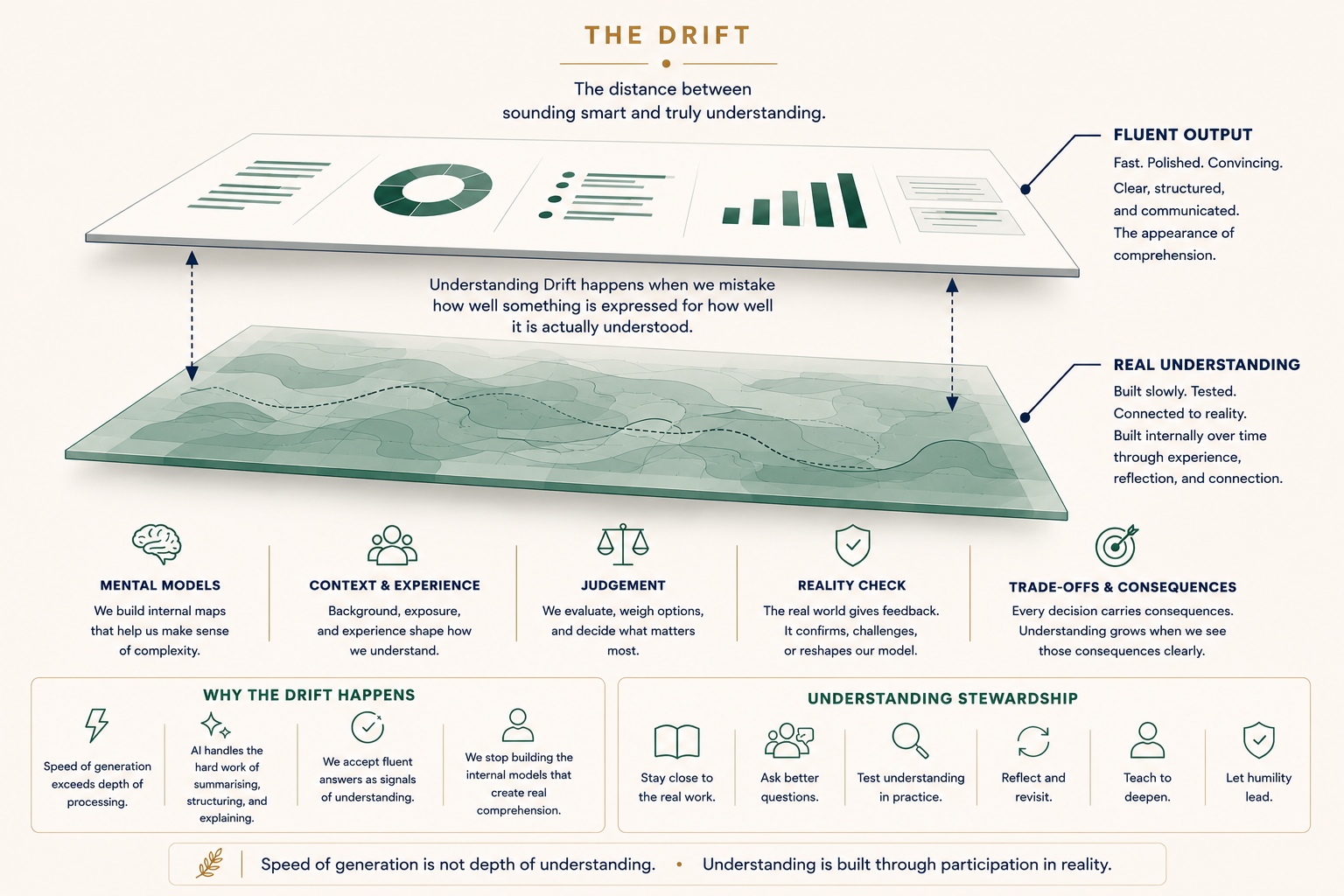
AI can increase our ability to express understanding faster than it develops our constructed understanding.
The growing distance between those two conditions is what I call Understanding Drift.
It is the gradual weakening of human comprehension when fluent outputs begin to substitute for the mental models that should have been built underneath them.
It is not a failure of artificial intelligence.
It is a challenge for human learning.
Understanding Is Not the Possession of Answers
A child asks why the sky changes colour at sunset.
A student memorises a scientific law.
A technician diagnoses a failed process.
An enterprise architect designs a digital platform.
A leader approves a transformation programme.
These activities look very different, yet they all depend on the same human capability: constructing meaning from information, experience, context, and consequence.
We often speak as though information, knowledge, explanation, and understanding are interchangeable.
They are not.
Information tells us what happened.
An explanation tells us how it happened.
Knowledge begins to tell us why it happened.
Understanding asks a different question altogether:
What reality produced this outcome, and how would that reality behave if something changed?
Consider an enterprise system failure.
Information tells us that an inventory transaction failed.
An explanation identifies the error code.
Knowledge links that error to a familiar integration or master-data issue.
Understanding asks what was actually happening on the warehouse floor.
How was the pallet scanned?
Which informal workaround had quietly evolved over months but never appeared in the documentation?
Did an upstream design decision create a downstream problem that looked unrelated?
Would correcting the technical error solve the problem — or merely hide it?
This is where experience begins to matter.
In enterprise work, the first answer is often not the most important one. A technically correct explanation can still miss the human behaviour, organisational constraint, or operational reality that made the incident possible in the first place.
That is something many of us learn only after years in the field: the real issue is often not the error message. It is the gap between the formal system and the way people actually work.
Understanding is not the retrieval of a correct answer.
It is the construction of a mental model strong enough to support questioning, adaptation, and judgement.
In this essay, I use understanding to mean an internally constructed model that enables a person to explain relationships, challenge assumptions, apply principles in unfamiliar situations, and revise their thinking when reality refuses to behave as expected.
That internal construction cannot simply be transferred.
Definitions can be shared.
Documents can be copied.
Frameworks can be taught.
Understanding must be reconstructed by each learner through attention, comparison, experience, uncertainty, and reflection.
This explains why someone can complete every step of a technical exercise yet become uncertain the moment one condition changes.
They possess the procedure.
They do not yet possess the system.
The opposite is equally revealing.
Experienced professionals often solve problems no manual anticipates because expertise is not merely the accumulation of instructions. It is the gradual refinement of relationships between causes, conditions, patterns, and consequences.
Understanding is not the possession of answers.
It is the capacity to ask better questions when the answers begin to fail.
The Work That Happens Before an Answer
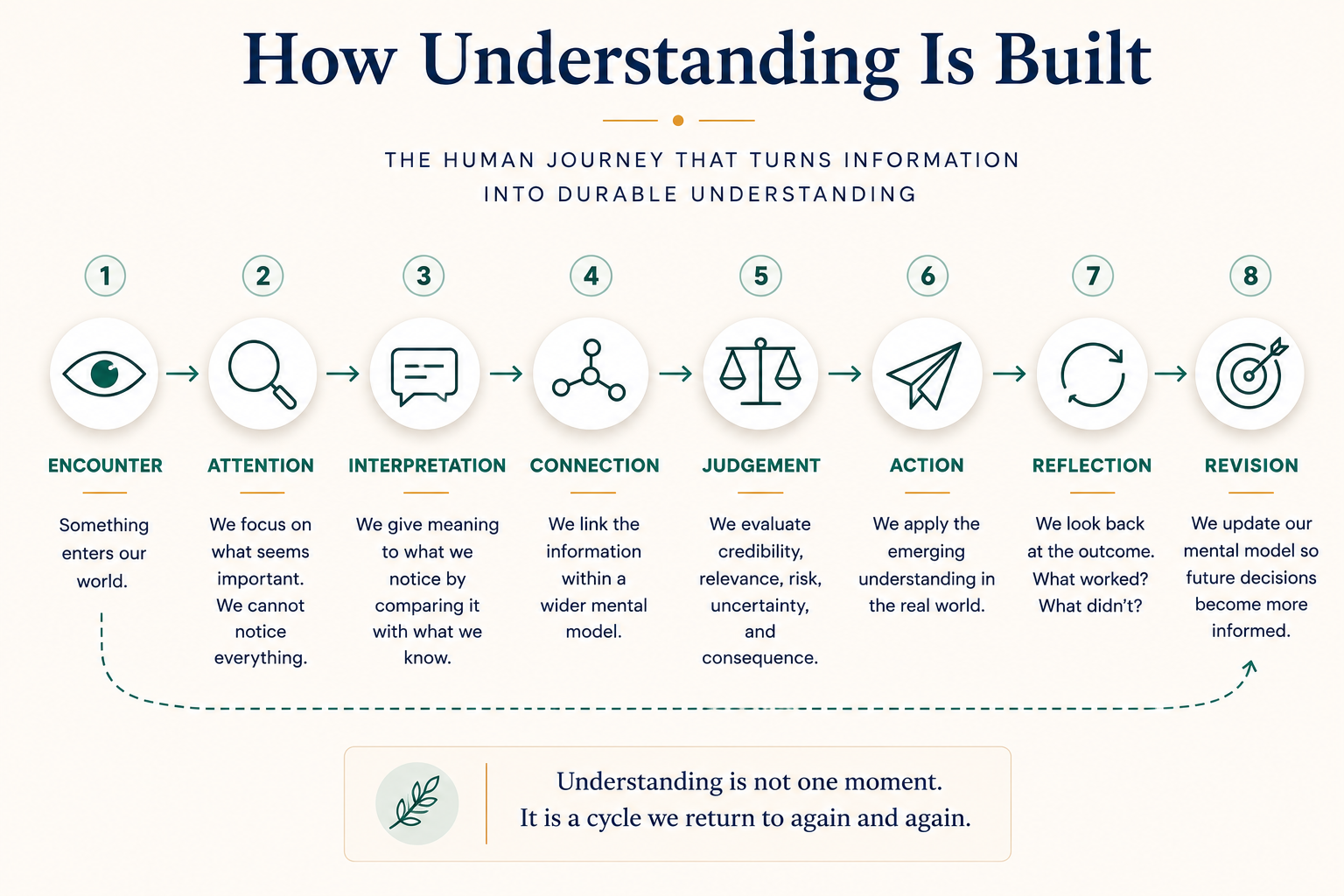
Before any decision is made, a remarkable amount of invisible work has already taken place.
We encounter.
We attend.
We interpret.
We connect.
We judge.
We act.
We reflect.
We revise.
Understanding is rarely a single moment of insight. It is the cumulative result of moving through these stages, often repeatedly.
We begin by encountering a problem, a claim, an unexpected result, or an unfamiliar situation.
Attention decides what deserves notice.
Interpretation gives meaning to what we have noticed by comparing it with prior knowledge, expectations, and experience.
Connection places those observations within a broader mental model. We begin asking what caused the situation, how one event relates to another, and what similar patterns we have seen before.
Judgement evaluates credibility, uncertainty, and consequence.
Action applies that emerging understanding.
Reflection compares expectation with outcome.
Revision reshapes the mental model so future decisions become more informed than past ones.
Real thinking is rarely linear.
New evidence changes interpretation.
Unexpected outcomes redirect attention.
Conversation exposes assumptions we did not realise we held.
Failure often teaches more than immediate success because it forces us to rebuild the mental model rather than simply confirm it.
Understanding develops through participation in this journey — not merely through receiving the destination.
Artificial intelligence can now participate in almost every stage of that process.
It can determine which information we see first.
It can suggest where our attention should be directed.
It can provide an initial interpretation before we have formed our own.
It can identify patterns, propose causal relationships, recommend actions, and summarise the results.
Each capability can be valuable.
The deeper question is what happens when we repeatedly bypass several stages of understanding at once.
When a system selects, frames, interprets, connects, and recommends on our behalf, we may still produce successful outcomes.
The report is delivered.
The presentation is persuasive.
The decision appears sound.
The visible work has been completed.
What may be missing is the invisible work through which durable understanding is normally constructed.
The output remains.
The mental model may not.
The Appearance of Competence
One of the most significant changes introduced by AI is not that it produces better answers.
It changes what competence looks like.
Human beings are naturally inclined to associate fluent language, clean structure, and polished presentation with expertise. AI weakens that historical relationship by producing the appearance of competence without always requiring the depth that used to justify it.
In enterprise consulting, technical reviews, and transformation programmes, that appearance is everywhere.
A team presents an elegant architecture deck.
The diagrams are clean.
The terminology is current.
The roadmap is convincing.
Then someone asks a simple question.
Why was this integration pattern chosen for this particular legacy environment?
What happens to frontline operations if the overnight batch process is delayed by two hours?
Which assumption must remain true for this design to succeed?
The confidence begins to fade.
The presenters can explain what the slide says.
They struggle to explain why the reasoning beneath it is sound.
Sometimes the material came from an existing template.
Sometimes it was inherited from a previous project.
Increasingly, it begins as an AI-generated draft.
In every case, the visible artefact can appear more mature than the understanding of the people presenting it.
The same pattern appears in learning.
A learner follows every step correctly and produces the expected result.
Then one condition changes.
Progress stops.
The competence was attached to the procedure — not yet to the person’s mental model.
AI introduces a new intermediate stage that deserves our attention.
For much of modern education, learning followed a familiar path:
I don’t know → I understand → I become proficient.
Today another stage is becoming increasingly common:
I don’t know → I can produce convincing output → I understand → I become proficient.
That middle stage is not inherently bad.
It can help beginners communicate, explore new fields, and accelerate learning.
The danger is that it feels remarkably similar to genuine understanding.
For the first time in history, many of us can produce the language, structure, and appearance of expertise before we have constructed the capability those signals once represented.
The ability to produce a persuasive answer is no longer reliable evidence that the answer has been understood.
Why This Matters
This is not simply a philosophical concern.
It is already becoming part of everyday work.
A manager receives an AI-generated meeting summary and assumes the important issues have been captured.
An architect reviews an AI-assisted design because it looks coherent and professionally structured.
An analyst presents a generated explanation with confidence because the wording sounds authoritative.
A leader approves a recommendation because the final document appears complete.
None of these actions is inherently problematic.
Many AI-generated outputs are excellent.
The risk is not poor quality.
The risk is quiet dependency.
When generated structure becomes our default starting point, we may gradually lose the habit of constructing structure ourselves.
When generated explanations become our first interpretation, we may question less.
When generated recommendations become our normal way of deciding, we may practise judgement less often.
The immediate consequence is greater efficiency.
The long-term consequence may be weaker adaptability.
For organisations operating in stable environments, that difference may remain invisible for years.
But uncertainty eventually exposes the quality of every mental model.
Markets change.
Technologies evolve.
Customers behave unexpectedly.
Systems fail in ways no one anticipated.
It is in those moments that organisations discover whether they possess genuine understanding — or only convincing outputs.
If this pattern spreads widely, the consequences will not stay inside the organisation. We may begin to mistake fluency for understanding across education, public discourse, professional work, and even the way society makes important decisions. The danger is not always obvious failure. It is increasingly polished language resting on increasingly fragile mental models.
What Should Remain Humanly Practised
None of this suggests we should reject artificial intelligence.
That would be both unrealistic and unnecessary.
The purpose of AI is not to replace human thinking but to expand what human thinking can accomplish.
The challenge is deciding which forms of thinking should never become optional.
Some cognitive practices deserve deliberate protection because they are where judgement, responsibility, and learning are formed.
These include:
- framing the problem before generating solutions
- questioning assumptions rather than accepting the first explanation
- maintaining contact with original evidence rather than relying only on summaries
- independently synthesising ideas before refining them with AI
- exercising judgement when evidence is incomplete or uncertain
- reflecting on outcomes so that future decisions become wiser than previous ones
These are not simply professional skills.
They are the disciplines through which understanding continues to develop.
If intelligent systems increasingly perform the visible work of thinking, these invisible practices become more — not less — valuable.
Understanding Stewardship
If Understanding Drift describes the challenge, Understanding Stewardship describes the response.
It begins with a simple recognition:
Human understanding is not an operational cost to minimise.
It is a capability to cultivate.
For organisations, this means measuring more than speed.
More than efficiency.
More than output.
It means asking questions that rarely appear on performance dashboards.
Did this process make our people more capable of reasoning independently?
Did the use of AI strengthen their judgement — or simply reduce their effort?
Can the team explain its decisions without relying on generated language?
Have we accelerated learning — or merely accelerated production?
These questions may become increasingly important as intelligent systems mature.
Because the quality of our outputs will no longer reveal the quality of our understanding.
A Different Measure of Progress
For generations, progress has often been measured by how quickly we can produce answers.
The age of intelligent systems invites a different measure.
Not simply:
How fast did we finish?
Or:
How polished is the result?
But:
What kind of thinkers are we becoming in the process?
The greatest contribution of artificial intelligence may never be that it answers more questions.
It may be that it forces us to think more carefully about what it means to understand in the first place.
If that is true, then the future of intelligence will not be defined only by what machines can do.
It will also be shaped by what human beings continue to practise.
Intelligent systems will increasingly participate in thought.
The challenge is not to prevent that participation.
It is to ensure that assistance never quietly becomes absence.
Because in the end, our responsibility is not simply to produce better answers.
It is to remain capable of constructing understanding for ourselves.
Perhaps that is the real test of the AI era.
Not whether machines can become more fluent.
But whether we continue to build understanding, rather than merely sound as if we have done so.
About the author
Veera Babu Tiragatla writes about enterprise systems, AI, and the human side of understanding. His work explores how intelligent systems are changing the way people think, decide, and learn. Understanding Drift is the first essay in The Understanding Project, an ongoing exploration of human understanding in the age of intelligent systems.